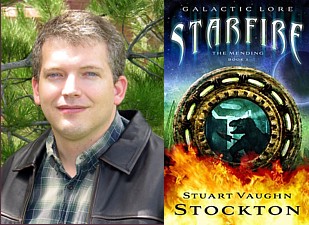
Please Welcome...Stuart Vaughn Stockton
This month our interview guest is Christian speculative fiction novelist Stuart Vaughn Stockton. Stuart is one of those guys you meet who has...let's call it a rich inner life. His body may be here, but his mind is in a far-off galaxy inhabited by advanced creatures bearing more resemblance to T. Rex than you or me. He says he was only two years old when he managed to blow up an electrical outlet using only a pinto bean and a metal fork. We speculate that this may help explain how his brain became calibrated toward the weird side. Nevertheless, Stuart is quiet, stable, and always thinking. And he does have at least one foot in the real world--he has to, now that he's got a new baby girl with his wife, fellow Christian novelist Amber Miller (a.k.a. Tiffany Stockton). I first encountered Stuart when I was launching Realms over at Strang Communications. I loved his bizarre science fiction story about non-human, non-earth lizard characters trying to save their empire on some distant world. But I knew I'd never be able to get it published through traditional Christian publishing channels. I was very pleased, a few years later, to be able to acquire it for Marcher Lord Press. As a teen, Stuart began creating characters and stories that, over the ensuing twenty years, steadily built into the mythos of Galactic Lore, a universe of stories that includes the world of Sauria, on which his first novel, Starfire, takes place. Stuart had become something of a cult figure in one corner of Christian publishing even before he ever got a contract. Stuart became friends with bestselling Christian novelist Brandilyn Collins when she was looking for a character inspiration for her Kanner Lake series of novels. She ended up creating S-Man, a character who hangs out in a popular coffee joint always talking about this strange science fiction novel he's writing. The book involves computer-using dinosaur characters and an ancient doomsday weapon. S-Man is, of course, Stuart, and the SF he's working on is Starfire. Fans of Brandilyn's novels, and many members of ACFW, know that Stuart is the basis for S-Man. Hence his somewhat legendary status in those circles. Just to blur the line a bit more, Starfire contains a page of signatures from Kanner Lake characters congratulating S-Man for finally getting his book published. So without further ado, here's the interview. WhereTheMapEnds: Catch us up with you. What have you been up to lately? Stuart Vaughn Stockton: Mostly I’ve been adjusting to life as a dad. Our first baby, Victoria, was born on April 2nd. I’ve been having a fun time getting to know her and experiencing the wonders of fatherhood. Other than that I’ve been doing what I can to get the word out about Starfire and the rest of Marcher Lord Press’s great books while I get back into the world of Sauria to continue Rathe’s adventures. WhereTheMapEnds: What is your favorite speculative novel of all time (Christian or secular) and why is that your favorite? Stuart Vaughn Stockton: I don’t really have a favorite novel of all time one way or the other. Tolkien’s and Lewis’s works are the only novels I’ve read more than once. The one series that really kicked me into serious consideration of writing was R.A. Salvatore’s Cleric Quintet and the way the main character’s faith journey was explored. WhereTheMapEnds: What made you want to write Christian speculative fiction? Stuart Vaughn Stockton: I’ve always been a big fan of science fiction and fantasy, so speculative fiction is what came naturally to me. Honestly, I don’t think I could write anything else, as my creative process just doesn’t work that way. WhereTheMapEnds: I think most novelists tend to write in the genres of books they've been most impacted by. We want to recreate that impact and wonder and joy in the lives of others--and in ourselves. So how was your first idea for a Christian speculative novel received (by anyone: spouse, friends, parents, agent, publisher, readers, reviewers, etc.)? Stuart Vaughn Stockton: I’ve been blessed with very supportive family and friends who have always acknowledged I’m a little weird, but also encouraged me to develop my story ideas. The first idea I actually tried to write as a novel was about a group of teens who discovered some sleeping dragons beneath the mountains of Colorado and became a kind of superhero team. My first completed manuscript was Starfire. While all my family and friends loved it, anyone who would actually have to take a risk on it (like agents and editors) shied away—which I don’t fault them for. The concept of alien dinosaurs not written for young adults isn’t what anyone thinks of when they think of CBA. WhereTheMapEnds: What is your favorite speculative genre to read? To write? If they’re different, talk about that. Stuart Vaughn Stockton: I actually read fantasy the most, and I think my writing is more like fantasy than science fiction. Early on while thinking of Starfire I remember reading an article on fantasy where the author commented how most of the authors of fantasy following Tolkien had all their characters seeking to obtain an object of great power to defeat evil, while Tolkien had his characters seeking to destroy an object of great power to defeat evil. That struck me as quite interesting and I wondered what it might be like to combine those goals in a story. That’s partially what led me down the path of finding Karey Or and forcing Rathe’s decision with the Starfire. WhereTheMapEnds: Fascinating. For the benefit of someone who might not know your premise, I'll say that the central question in Starfire is what our protagonist will do with a superweapon that might save his empire--or destroy his world. Should he use it or destroy it? How would you characterize the current state of Christian speculative fiction writing and/or publishing? Stuart Vaughn Stockton: I think the Christian speculative fiction writing/publishing relationship right now feels to me like a grown eagle still stuck in its shell. There are a growing number of excellent spec-fic writers out there honing their craft and crafting their tales, but save for a few sub-genres of spec-fic they are being held back by market forces that haven’t cracked open enough to let them break free and fly into the unknown. There are a large number of reasons behind this, but I think that part of it is because there are too many people out there who don’t know where to find this kind of fiction, or haven’t discovered that they want it. WhereTheMapEnds: Great word picture. Of course, my personal belief of why this is is that the fiction readers who buy CBA fiction are not those who want science fiction or fantasy. They want bonnet and buggy fiction.
But I do agree that there are many Christians who would love Christian
speculative fiction but don't know it's out there. These are the ones
who read Ted Dekker's books but then believe there's nothing else out
there like them. What have you seen that encourages you about Christian speculative fiction writing and/or publishing? Stuart Vaughn Stockton: There’s more opportunity for people who write speculative fiction from a Christian worldview to get their novels out to the masses now than there ever have been before. Independent publishers like Marcher Lord Press are springing up all over the place, and they are small enough to take risks that the more established houses can’t. Plus, the word is spreading that these books are out there. Maybe not as fast as the cosmic winds, but people are discovering that these weird books are available and that they are well-written. WhereTheMapEnds: What have you seen that discourages or frustrates you about Christian speculative fiction writing and/or publishing? Stuart Vaughn Stockton: It is easy for me to get discouraged when I think about how few people know about the great writing that is out there now.
There are great communities built up around Christian spec-fic, but
right now they’re the pioneers, blazing the trail and sending back
reports. Trying to get the word out about the wonders hidden beyond
the edges of the known world. Their efforts encourage me to keep spreading the word myself and to trust God will reward the faithful and that He uses each of us to touch lives with our writing. WhereTheMapEnds: What do you think Christian speculative fiction writing and/or publishing will look like in three years? Five years? Ten years? Stuart Vaughn Stockton: The writing aspect, I imagine, will look a lot like it does now, though perhaps people won’t have to go so long in solitude without an understanding community as those that exist now grow and mature. When I first started writing spec-fic, these communities didn’t exist (as far as I know). It was a pretty lonely start. As for publishing, I hope it will have grown more mainstream in the public knowledge. The industry is struggling to figure out how to get through this economy and what to do with the digital side of the business. The slush of available books will probably get bigger, which will make it harder to stand out, but I think the ability to find good Christian spec-fic will increase. WhereTheMapEnds: I certainly hope you're right. So, Stuart, what advice would you give to someone who aspires to write and publish Christian speculative fiction? Stuart Vaughn Stockton: Keep your focus on God and allow Him to speak to you through the writing experience. Don’t worry about putting lessons in for other people, but try to hear God speaking to you through the trials and adventures you chronicle for your characters. Don’t listen to the industry experts about what is marketable until after you’ve written a novel or two that stir your heart. Worrying about if what you’ve written will be published will only cause you to be distracted from your story. [Ed.: And paralyzed.]
Finally, have fun. Go crazy and write the story that sings in your
heart. And always keep pressing forward. WhereTheMapEnds: Good advice, Stuart. What’s the best part about writing and publishing Christian speculative fiction? Stuart Vaughn Stockton: For me, the best part about writing Christian speculative fiction is the chance to explore different worlds and examine how God might work on those worlds.
As for the publishing part, what I love most is hearing back from
readers who have finally gotten to experience the world I’ve been
exploring myself. I love learning what they saw or if they discovered
anything I hadn’t seen. Stuart Vaughn Stockton: Right now I’m in the early stages of work on the sequel to Starfire, tentatively titled, Shenkai. This next stage in Rathe’s adventures picks up shortly after the events in Starfire and will explore the consequences of Rathe’s decision and unveil more of the secrets of Sauria and the greater Galactic Lore mythos. WhereTheMapEnds: Excellent. What’s a cool speculative story idea you’ve had lately? Stuart Vaughn Stockton: The latest formed idea is a story about a young boy in 1880s Texas who discovers a steam-powered armored suit and is recruited to help in a fight against a highly-advanced alien race. Something like steampunk vs. lasers. WhereTheMapEnds: Way cool. I was just sitting here thinking that what we need is a Wild West steampunk novel with aliens. Oh, yeah, baby! Well, Stuart, what else would you like to say to readers of WhereTheMapEnds? Stuart Vaughn Stockton: Don’t stop dreaming or asking weird questions. It doesn’t take much looking around to see that God delights in the weird and unexpected. He uses the foolishness of this world to confound the wise, so don’t be afraid to be a little foolish. And keep spreading the word about all the great speculative titles that are coming out from Christian authors. It’s up to all of us to help keep places like Marcher Lord Press going by rewarding them for taking the risk to deliver the stories we’ve all been longing for. That's All for This TimeGreat interview, Stuart! Thanks for stopping by. Be sure to visit Stuart online. If you missed the previous months' interviews with other speculative authors, including Frank Peretti, Jerry Jenkins, Karen Hancock, Tosca Lee, and Ted Dekker, you can read them here. And be sure to come back next month for an interview with another mover and shaker in the world of Christian speculative fiction.
|
Sign up for the
WhereTheMapEnds
 
|